

Austin Midwife Spotlight: Joanne Chiwaula

joanne chiwaula

With our Austin Midwife Spotlight series, we’re giving our beloved midwives an outlet to express why they love what they do. Today, we’re spotlighting Joanne Chiwaula, RN, CNM, MSc. Joanne did her undergraduate studies at Brown University and obtained her RN, MSc and CNM from the University of California, San Francisco. She spent more than nine years in Africa, first practicing as a midwife in Malawi, then teaching nursing and midwifery in Ghana. Joanne remains passionate about pregnancy care in Africa and started her own nonprofit to support mothers there – African Mothers Health Initiative.

What, in your opinion, separates a true birth center from a hospital birth experience?

It is not the location that makes the difference but the policies and practice.  AABC is an accredited birth center providing true midwifery care.

How does the level of personal care differ between an OB/GYN and an AABC midwife?

Midwives believe that healthy pregnancies and normal deliveries are best supported when care is provided in partnership with women and their families. This means that midwives prioritize active participation of women and their partners.  Midwives strive to do as much or more listening as educating and evaluating.  Simply put, women more time with the midwife prenatally (i.e. longer visits) than they would with an OB, midwives also strive to be accessible to the families in their care.

How does AABC being around for 28 years set it apart from other birth centers? Is there something about it that’s unique to the fabric of Austin?

The longevity of the birth center is something very special.  It is well known and respected by Austin women but it is also known and respected by other obstetric practices in Austin.  In the cases when women must transfer, midwives at AABC are allowed admitting privileges.

Why did you want to become a midwife? How do those ideals guide your work today?

I studied international development in my undergrad and I wanted to provide compassionate care to women who needed it most.

What’s your favorite part about working at AABC?

It is wonderful working with a group of kind intelligent women who practice evidence based care and strive to provide the best care for their clients.  I love having the freedom to provide true family centered care.  AABC is a beautiful place to work and to deliver.

What advice do you have for moms choosing where to have their birth?

You should choose a setting where you feel safe and where you trust your providers.
Austin Midwife Spotlight: Erika Brosnan

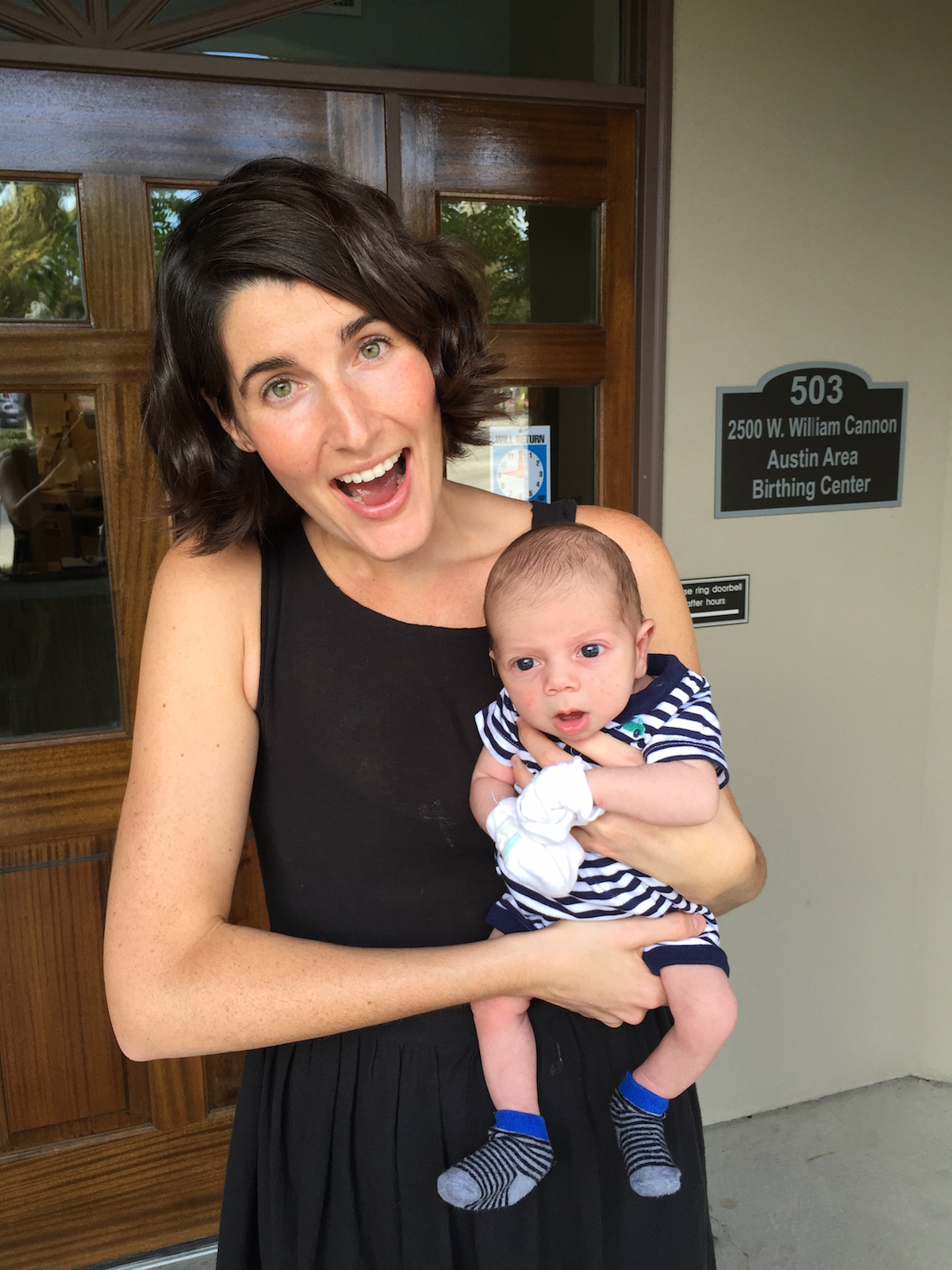
Austin Midwife Erika Brosnan

With our Austin Midwife Spotlight series, we are giving our beloved midwives an outlet to express why they love what they do. Today, we’re spotlighting Erika Brosnan, who is an RN, CNM, MSN!

Why did you want to become a midwife? How do those ideals guide your work today?

My path to becoming a midwife has been a relatively smooth journey. Figuring out a career path is really difficult for many people, so I am grateful that my decision to become a midwife felt effortless.

Things seemed to fall into their place. I worked as an ICU nurse for a few years. While I enjoyed my time and experience in ICU, I personally struggled with the tragedy and loss that is commonplace in critical care. I decided to change directions. Labor and delivery was the perfect fit. In my quest to get an L&D job, I began researching birth in America and reading/learning about midwives. There was not a question in my mind about whether or not this was the right fit for me. While in L&D, the unit I worked on happened to have a small practice of midwives that delivered there. I still remember the first birth with a midwife: it was calm and intimate, nothing like I had seen with any of the OB’s I worked with. I am drawn to midwifery because it is a profession that promotes calmness, patience, trust in women, and belief that pregnancy is a normal state of being.

What are the main differences between your approach to birth and the typical hospital birth?

I think hospital birth is often times a “production.” Lots of bright lights, birth gear, and they can involve a crowd of spectators. I think our standard practice at the birth center is the opposite of that. We want the enviroment to be private with nice lighting (or no lighting at all!), with few interruptions. We want to give each woman what she needs to be able to birth her baby. There is no formula, so we have to be tuned in with each woman we provide care for.

Do you have any favorite memories from your time at AABC?

There was one wild night I will never forget. It was Friday the 13th of February, there was a supermoon and a cold front that had come in, which apparently was the perfect recipe for putting women into labor. We had five babies born that night, all of which were girls. It was fun to get to be a part of.

What to you is the most rewarding aspect of being a midwife?

I am a huge fan of Centering Pregnancy. I find it really rewarding to get to facilitate Centering groups. The whole concept of Centering is genius; it puts into practice the saying “it takes a village.” We live in a culture that is not supportive to new moms.  Women often feel isolated and alone after having a baby. Centering provides a network for new moms (and dads) to feel connected. I think AABC as a whole functions this way, but I love the way it is cultivated through the Centering program.

If you could tell expectant mothers one message, what would it be?

There are many things that are out of your control in regards to pregnancy and birth. Take ownership of the things you can control and be fluid with those that are out of your control.

Labor Pains: Surprising Statistics About Hospital Birth in the United States

In the United States, there tends to be an assumption that you’re going to receive world-class healthcare – especially when it comes to giving birth. With as much hospital infrastructure as we have in this country, you’d think we’d have one of the lowest infant and maternal mortality rates in the world. Unfortunately, that’s not true. The U.S. currently ranks 28th in maternal mortality and with an infant mortality rate of 6%, we’re well behind dozens of other countries. On top of that, the U.S. spends more on giving birth than any other country. Hospital births are not meeting the needs of American parents. 

American mothers are conditioned to believe that the best place to give birth is in a hospital. How often do you see someone give birth with a midwife on TV or in a movie? The assumption is that the hospital is the place to have a baby. This idea is so ingrained that only 8% of U.S. births are delivered by midwives.

Modern research is showing us that the current system is flawed. In the United Kingdom, midwives attend 68% of births and the impact on patient outcomes is clear. The maternal mortality rate in the United Kingdom is ⅓ what it is in the United States, and births are considerably less expensive. Midwife delivery is so effective in the U.K. that the National Health Service recommended midwife delivery over hospital delivery for low-risk pregnancies.

Far from being antiquated, midwives provide a level of care to mothers that you won’t find in hospitals. Midwives understand the birth experience and the value of a natural birth. At Austin Area Birthing Center, we take pride in our low rates of medical intervention. We have a lower rate of preterm birth, caesarean section, episiotomy, and IUFD than the hospital average.

In addition to better safety outcomes, we provide complete care to mothers, babies and their families. AABC moms give birth their way, whether it’s at home, in one of our birthing beds, or in a birthing tub. Our master midwives are with them every step of the way, providing emotional support along with birth expertise. Having a baby should be a beautiful, natural event, not an expensive, harrowing experience.

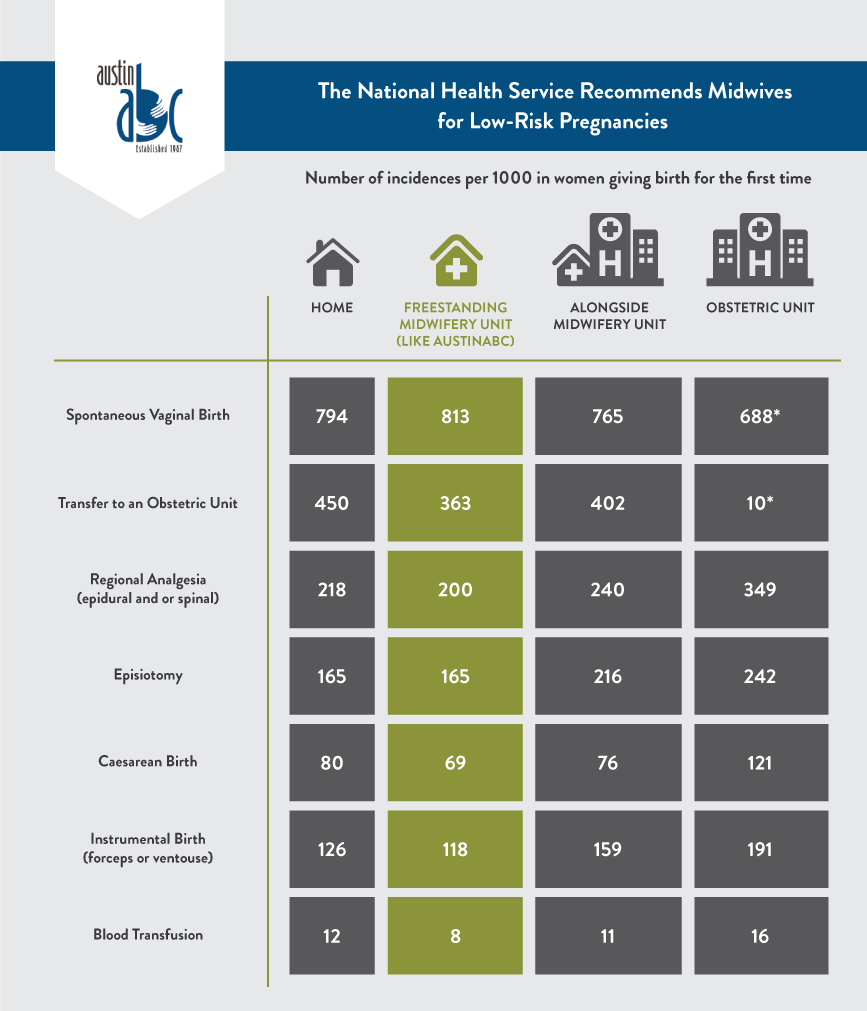
AABC-Infographic-Rec-Midwives2-2

Austin Midwife Spotlight: Joan Smith

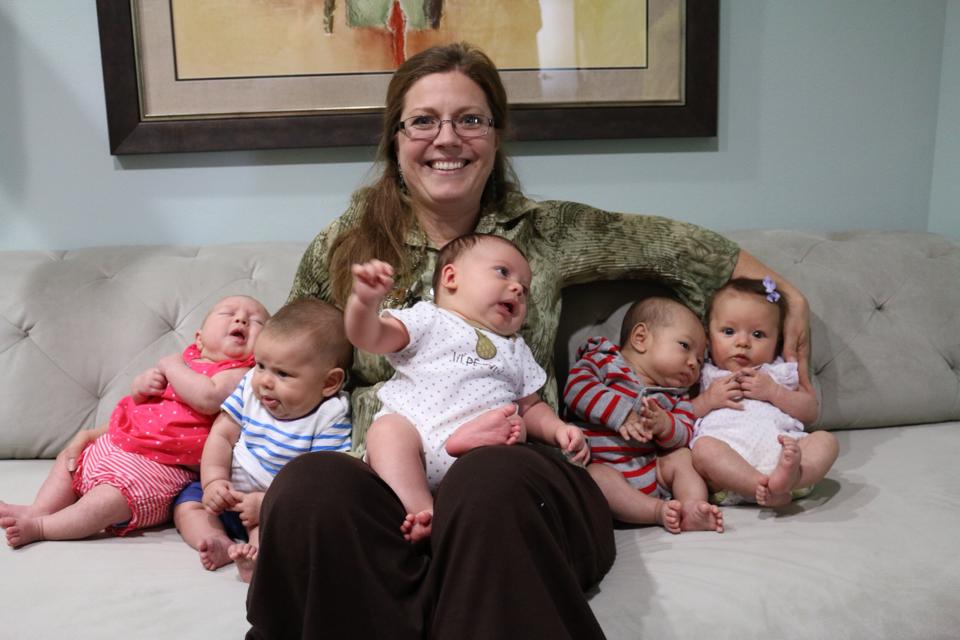
Austin midwife Joan Smith with babies from her centering group

Austin midwife Joan Smith with babies from her PregnancyCentering® group

With our Austin Midwife Spotlight series, we are giving our beloved midwives an outlet to express why they love what they do. Our first interviewee is Joan Smith, who has been with us for 13 years!

What, in your opinion, separates a true birth center from a hospital birth center?

Well, a freestanding birth center, such as AABC, is not run by the hospital, and in our case, we are providing the benefits of the evidence-based midwifery model of care, which leads the way in safe, satisfying and cost-reduction in maternity care. But most importantly, we are accredited, which means we are held to the highest standards of safe, high-quality care for mothers and babies. To be accredited, we must only employ highly qualified staff, and properly train them to give safe and evidence-based care. We must not employ the invasive and risky interventions that a hospital or unaccredited birth center might use.

We also must perform frequent risk assessments on our clients, to insure that only low-risk clients are provided for, with the plan of out-of hospital birth.

How does the level of personal care differ between an AABC midwife and an OBGYN?

Well, not all OBGYNs are the same, but in general, one of the biggest differences between our care, and midwifery care in general, is that we spend much more time with our clients. During prenatal care we always have 30-60 minute appointments with our clients, and in Centering we have 2 hour appointments with our clients at every visit. This gives us time to get to know each other, find out what each mother needs, and provide the complete assessment, education and enhanced education, which are the hallmarks of the Midwife Model of Care.

The Midwife Model of Care is in contrast to the Medical Model of Care, which is based on the idea that the client needs to be cured of disease processes, either through medicine or surgery.

For our healthy, low risk mothers, and babies, this only interferes with the physiologic, normal process of pregnancy and labor.

How does AABC being around for 28 years set it apart from other birth centers? Is there something about it that’s unique to the fabric of Austin? 

Experience is the one thing you cannot buy or sell, and with experience comes wisdom. We have had time to determine what works the best for our community, and are always striving to improve and meet their needs. In the 13 years I have been at the birth center, I have never seen more hard-working and dedicated staff, who are creative and incredibly determined to be the best they can be as professionals, and advocates for our clients.

The other benefit of our being the most experienced birth center, as well as the largest birth center in the country, is that our track record of safety is there for all to see. All of our health statistics and outcomes are available through the state’s Department of Health Statistics. As we are an accredited birth center, our statistics are also kept and compiled by the American Association of Birth Centers, and are published regularly.

As members of this organization we have access to these to insure we are monitoring our own safety and quality of care. They are also published regularly, as in the Journal of Nurse-Midwifery.

We are unique among all the birth centers in Texas, that we’re also providing the innovative program of CenteringPregnancy® group prenatal care. We are the only out-of hospital Centering site, which has been shown in study after study to lower the rates of premature birth, low birthweight babies, and infant mortality, as well as many other associated birth outcomes. It also increases breastfeeding rates and has been shown to improve outcomes in mothers’ experiences of prenatal care, undeniably the wave of the future. We are very excited that we are the recipients of the March of Dimes’ support in this program, through grants and education of our staff to provide our services.

How did you find out about AABC?

Through the American College of Nurse-Midwives. I am a member now for 20 years, and have been an active chapter member within this association.

Why did you want to become a midwife? How do those ideals guide your work today? 

After working as a labor and delivery nurse for 9 years, and seeing how OBs had managed low-risk, normal pregnancies as if they were high-risk, causing the over-use of technology, I noticed that these created complications and poor outcomes for these mothers and babies. I wanted to provide an alternative, to improve maternity care. I wanted a chance to focus more on education, and have more time caring for our clients as a partnership.

As a feminist, and a humanist, I was appalled at the perils of “state of the art” care in the hospitals. Especially the private, physician-owned hospitals that made more money, the more they did to intervene. I became a nurse and midwife educator, in birth centers, hospitals and in hospital-run birth centers. Of all of these I found the best experiences and outcomes in freestanding, accredited, midwife-led birth centers. That is why I am still here today!

As a midwife, there is nothing to compare with the loving, family and woman-centered care and the camaraderie I enjoy at AABC!

I wanted to care for women through their lifespan, not just at the time of birth, so that I could develop a relationship with them, and help prevent complications, and have a more enriching as well as meaningful experience through these relationships.

What’s your favorite part about working at AABC?

Being with the women we serve, and their families, year after year, watching their families grow and flourish!

I also feel like I am part of a big family at AABC, with lots of big and little sisters, working together and playing together, watching their families grow as well!

Do you have any favorite memories from your time at AABC? 

So many, hard to start and recount them. The wonderful parties and reunions for our birth center clients are a big highlight, the women having triumphant VBAC births after their Cesareans, and especially our fellow midwives’s births at the center!

What advice do you have for moms choosing where to have their birth?

Do your research, and educate yourself and your family by looking at the evidence. Visit with your prospective providers and ask questions, and search your hearts and your families’ hearts, to find a place and caregivers that you trust. Nothing matters more to most women than their birth experiences and outcomes, and above all, trust yourself!

National Health Service Recommends Midwives for Low-Risk Birth

The experts at the National Health Service in the UK have changed their birthing guidelines to suggest that low-risk women avoid hospital births.

Low-risk pregnancies make up about 45% of all pregnancies. Low-risk women who deliver under a midwife’s care demonstrated lower rates of many different complications, including episiotomy, caesarean sections and instrumental birth, compared to counterparts who delivered at hospitals.

The recommendation is a change from NHS guidelines that were released in 2007, and reflects the growing awareness that natural birth under midwife care is not only a good option for mothers, but often the best option.

The guidelines compared four options for delivery – hospital birth, hospital-attached midwifery unit, freestanding midwifery unit, and home birth. The freestanding midwifery unit, like Austin Area Birthing Center, consistently led to better outcomes for mothers than the other three options.

AABC-Infographic-Rec-Midwives2-2