



The Myth of the Due Date, Explained

core values

An Austin Area Birthing Center mom recently wrote to us: “Help! I have three different due dates, and I don’t know which one is right!”

Here’s how that can happen. The average pregnancy lasts about 280 days or 40 weeks from the first day of the last menstrual period. But babies grow at different rates: some may arrive 2-3 weeks before the predicted due date, and some 2-3 weeks after. The baby was conceived after the menstrual cycle began—but the mystery is exactly when fertilization occurred.

Calculating the due date is important for a few reasons. One is to prevent induction of labor for a baby more than two weeks late (post-term). Another is to attempt to stop preterm labor (before 37 weeks). Finally, many tests and procedures are based upon the appropriate age of the baby.

Before ultrasound, one the best ways to calculate a due date was Naegele’s rule. Pregnancy calculators are based upon it. Count back three months from the first day of the last menstrual period, and add 7 days. For example, if the first day of the last menstrual period was February 20, then the estimated due date would be November 27.

However, Naegele’s rule and pregnancy calculators are based on a 28-day cycle and assume that ovulation occurred on day 14. For many women, cycles can be much shorter or longer, and ovulation generally tends to occur later rather than earlier. Sperm can also live for up to five days in the woman’s body prior to fertilization. So even when the date of intercourse is known, that is not necessarily the date conception occurred.

As ultrasound has become more sophisticated, pregnancies can be identified earlier.  Due dates can be calculated more specifically when performed early in the pregnancy because new babies begin growing at about the same rate. Once the pregnancy is more than 20 weeks, fetal growth can vary greatly, and by the third trimester, using an ultrasound for dating can be off by 3 or more weeks.

In women with long or irregular cycles, or if pregnancy occurred within three months of using hormonal birth control, then using the “last menstrual period” calculation won’t be as accurate as a first trimester ultrasound for dating. Even with regular 28-day cycles and a certain knowledge of your last period, women who underwent first trimester ultrasound for dating more likely delivered within 7 days of the ultrasound estimated due date than the due date calculated from their period.

In general, if an ultrasound was performed before the 14th week, and the estimated due date is 5-7 days different from the last menstrual period calculation, the ultrasound due date should be used. From 14-20 weeks, if the two due dates are as much as 10-14 days apart, the ultrasound date should be used.

It is really not uncommon to have been told several due dates. The important thing to know is how the due dates were calculated, and whether they are within a few days of each other.  Always talk with your provider about the due date and let them know as much as possible about your cycle frequency, when you think you conceived, and if you’ve had an ultrasound prior to visiting them for the first time. The rest is up to Mother Nature!
 

Understanding Ultrasounds

AABC-Ultrasound-Post-3

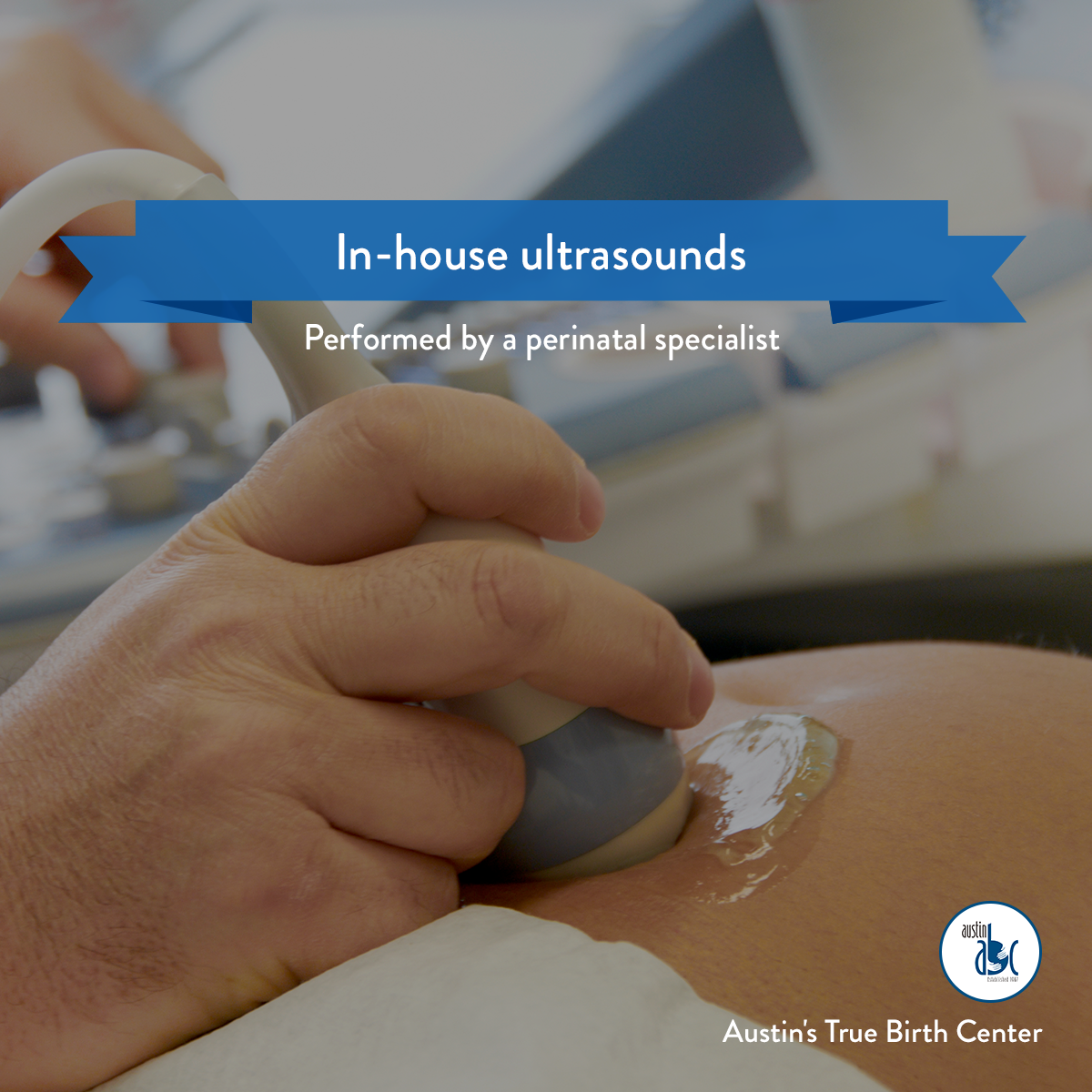
As a true birth center, we provide mothers with the same level of prenatal care that you’ll find at a doctor’s office, in a comfortable, supportive, midwife-led environment. That means that when you come in for checkups, we run all of the important tests, labs and screenings pregnant women need, including ultrasounds! We have in-house ultrasound machines at each Austin Area Birthing Center location and, thanks to our great relationship with Dr. Sina Haeri of North Austin Maternal Fetal Medicine, we have access to great ultrasound techs to conduct and interpret your ultrasound! This is uncommon in the birth center world, but we believe in providing our patients with the highest level of care possible.

You’ve probably already had an ultrasound, but if not, or if you just want to know more about the process, then read on!

What is an ultrasound?

An ultrasound, also called a sonogram, is a procedure that uses high-frequency sound waves to generate an image of the inside of your body. Technically, the procedure is called an ultrasonography procedure, ultrasound refers to the high frequency sound waves and the sonogram is the actual image that the waves generate, but most people just use ultrasound and sonogram interchangeably to refer to the procedure.

What is an ultrasound procedure like?

There are two types of ultrasound for pregnant women – transvaginal ultrasounds and the anatomy scan ultrasound that you see in movies and on TV all the time.  

Both types of ultrasounds are painless and relatively short. Transvaginal ultrasounds are conducted with a transducer probe that is inserted into the vagina. This is the kind of sonogram you’ll get during the early stages of pregnancy.

Once your baby has grown a bit more, when you come in for an ultrasound, the technician or doctor will rub some ultrasound gel on your tummy so that the machine can get a good reading. The person running your ultrasound will show you the scan and point out interesting things to you. Ultrasounds are hard to interpret to the untrained eye, but your doctor or tech will know exactly what’s going on. Once the scan is done, all you need to do is clean off the gel and you’re done!

When do I get an ultrasound?

Typically, pregnant women get their first ultrasound in the first trimester, once they determine that they are pregnant – around 6 to 8 weeks along. This is a transvaginal ultrasound, and you may be asked to come in with a full bladder, as the liquid in your bladder helps the soundwaves of the ultrasound machine get a clearer picture. This first ultrasound helps get all of the important stuff out of the way – you’ll get a more accurate idea of the date of conception so you can start charting milestones, you’ll know if you’re having more than one baby and the doctor or tech will be able to hear the baby’s heartbeat!

During your second trimester (around 20 weeks) you’ll get a comprehensive anatomy scan. This is the ultrasound as you probably imagine it – lying on a table with goop on your belly. At this point in your pregnancy, the ultrasound will reveal a detailed image of your baby! The person running the scan will check every part of your baby to make sure that development is on track. This is also the scan where you can find out the sex of your baby if you so choose!

If you haven’t run into any complications in your pregnancy, you probably won’t have any more ultrasounds before the baby is born!

At Austin Area Birthing Center, we aim to give moms the best care and community possible before, during and after pregnancy. By offering ultrasounds to our mothers, we’re able to make sure everything is healthy and help them see and bond with their baby before he or she arrives!

March of Dimes Centering Pregnancy Grant Featured in Austin American-Statesman

Our ongoing mission to provide Central Texas women with a true birthing center experience has been recognized by the March of Dimes! We received a $9,000 dollar grant from the organization to support our Centering Pregnancy program. The grant was mentioned this week in the Austin American-Statesman. We’re thankful to the March of Dimes for the grant and their commitment to Centering Pregnancy!

Beyond the Hospital: Natural Birth Methods for Natural Moms

If you’re anticipating a low-risk pregnancy, giving birth in a hospital isn’t mandatory (or even recommended)—you’ve got options! So what are some non-hospital birth methods for welcoming the newest member of your family into the world?

Home Birth: How many times have you cracked a smile reading about a automobile delivery when a baby just couldn’t wait until the car got to the delivery room to make their grand entrance? It’s a sweet notion after the fact (and after the upholstery gets a good wipe-down), but knowing there’s always the option of having your birthing help come to you could take a real load off your mind and cleaning bill.  Having an attending midwife right in your own home takes a lot of the guesswork out of packing, transportation, false-alarms, and what personal comforts you get to surround yourself with during and after your labor. Austin Area Birthing Center moms that opt for a home birth receive all of the counseling, checkups, classes and community available at AABC, we just bring the midwives to you on the big day.

Birthing Stools: Medieval Europe didn’t exactly get everything right when it came to matters of health—once-yearly baths and liberally prescribed bloodletting are practices we’re all better for having let fall by the wayside. Midwives way back when were on the right track with the birthing stool though, as sitting low to the ground in a squat-like position opens the hips and lets your body get gravity on its side (for once) during the last stages of labor. Talk about “sit and deliver.” Austin Area Birthing Center birthing suites are equipped with birthing stools and midwives who know how to use them.

Delivery Beds: We know what you’re thinking, you’ve got a bed at home already. But when you’re delivering in a birthing center’s special beds, you’re getting a little extra. A birthing center bed basically takes the expertly ergonomized lumbar support and surrounding knowledgeable staff of a hospital room and combines it with the privacy and intimacy of your mattress at home. The best of both worlds joined together can make a great environment to let you relax into both comfort and capable hands—and when the time comes to gear up and bear down, you and baby will really appreciate the mix.

Water birth:  For new moms that want the benefit of total surrounding warmth and lower pressure on her body—wetter could be better. It’s not exactly like a soak in a bath (no bubbles for one thing), but keeping the literal weight of the world off your shoulders during childbirth could be an enormous help.

Whatever birth method you choose, you’ll have a good amount of research and referencing to do as your baby’s debut date gets closer and closer, but don’t get overwhelmed! All that studying is only going to lead to a more informed, more prepared you, so that when the time comes, you can clear your mind of everything that isn’t deep breathing and unconditional love. And you can be sure that Austin Area Birthing Center is here to support you through it all.

TWC News Covers Austin Area Birthing Center’s Centering Program

TWC News visited Austin Area Birthing Center in July to get a first-hand look at our Centering Pregnancy prenatal care. The news crew interviewed AABC moms, as well as our midwife assistant Michelle, about the advantages of group prenatal care. The feature also highlighted the benefits of Centering Pregnancy, like the lower pre-term birthrate and higher breastfeeding rates!

https://youtu.be/DTgHYKv_VOk